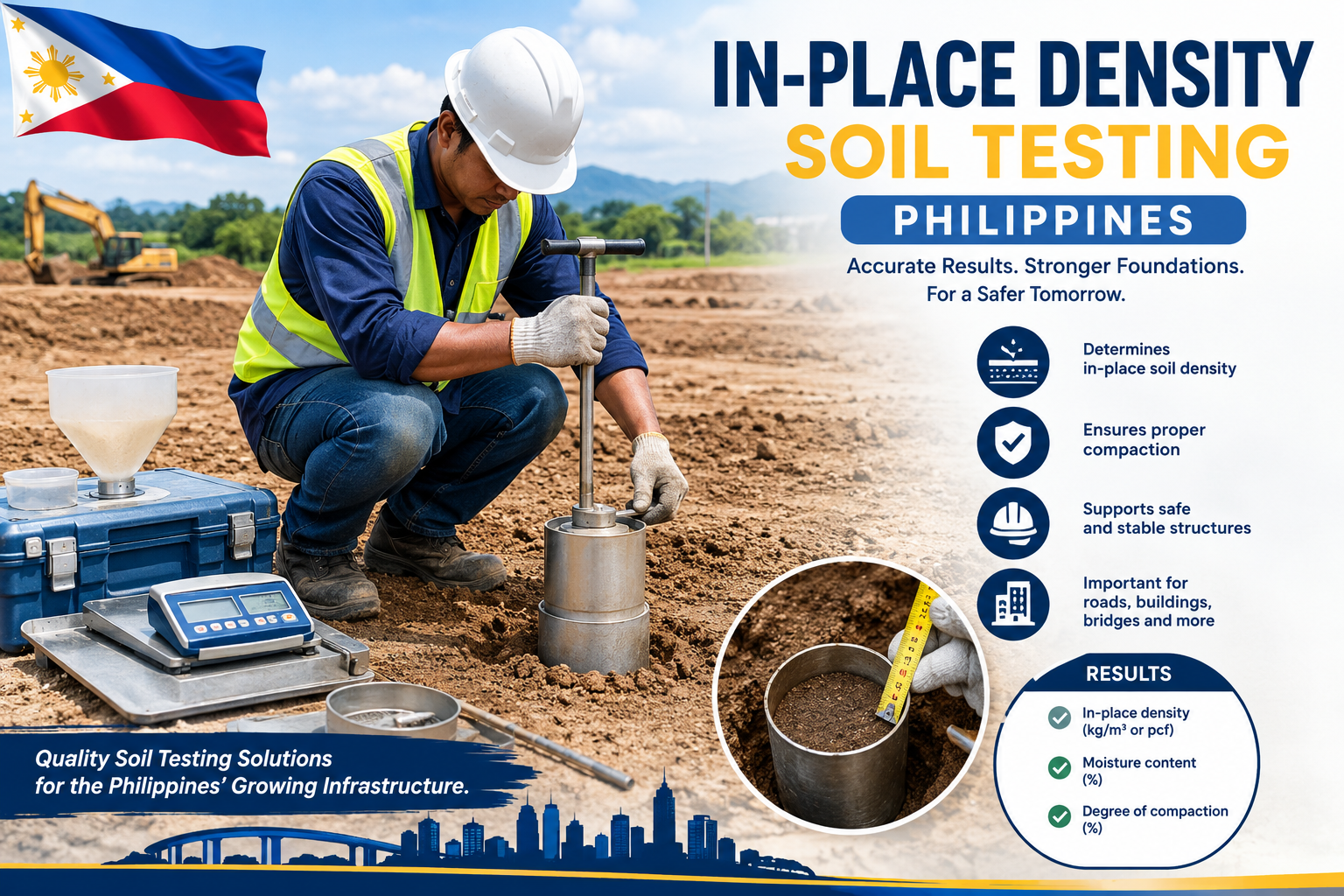
Construction projects depend on more than strong materials and good design. The soil beneath roads, buildings, foundations, embankments, pavements, and other structures must also have suitable density and compaction characteristics. This is where In-place density soil Philippines testing becomes an important part of construction quality control. Field density testing provides information about the actual condition of soil at the construction site rather than relying only on laboratory samples. It can help engineers and contractors determine whether compacted soil has achieved the required density for a particular project. ASTM standards recognize in-place density testing as a quality-control and acceptance-testing tool for compacted soil and soil-aggregate materials used in construction.
Understanding In-Place Soil Density
In-place soil density refers to the density of soil in its existing condition at a particular location within a construction site. It can be evaluated for naturally occurring soil or soil that has been placed and compacted as part of earthwork. Density describes how much mass is contained within a given volume of material. For construction purposes, understanding this measurement can help determine whether soil has been compacted adequately for its intended application. Field measurements can include wet density, moisture content, and dry density depending on the selected testing procedure. Nuclear density testing, for example, can measure in-place density and water content and can be used to determine dry density.
The term In-place density soil Philippines is therefore closely associated with field testing performed directly at construction sites. Unlike laboratory testing, which evaluates prepared soil specimens under controlled conditions, in-place testing examines the material where it has actually been placed. This distinction matters because construction conditions can vary significantly from one area to another. Soil may be affected by moisture, equipment, lift thickness, compaction effort, and material uniformity. A field density test gives project teams measurable information about those actual conditions. When properly performed, the results can support better decisions about whether additional compaction or other corrective work is needed.
Why In-Place Density Testing Matters in Philippine Construction
Soil compaction plays an important role in many construction activities throughout the Philippines. Buildings, roads, parking areas, sidewalks, industrial facilities, drainage structures, and utility installations may all involve compacted soil or fill materials. When soil is placed in controlled layers and compacted appropriately, the resulting material can provide a more stable base for subsequent construction. Poorly compacted soil, on the other hand, may be more susceptible to settlement or deformation under loads. The consequences can become more significant when construction continues without verifying the condition of the underlying material.
Field density testing gives construction teams an objective way to evaluate compaction. Instead of relying exclusively on visual observations or the number of passes made by a compactor, project personnel can use measured results to assess actual field conditions. ASTM’s current sand-cone standard identifies in-place density testing as a method used for compacted soils in applications such as earth embankments, road fill, and structural backfill. This illustrates why density testing can be an important component of construction quality control. For projects in the Philippines, the applicable testing method and acceptance requirements should always be established according to the project’s specifications and engineering requirements.
The Relationship Between Soil Compaction and Density
Compaction is the process of mechanically reducing air voids within soil by applying energy through equipment such as rollers, compactors, rammers, or other suitable machinery. As air is displaced and soil particles become more closely arranged, the density of the material can increase. However, achieving effective compaction is not simply a matter of applying more force. The moisture condition of the soil can significantly affect how easily the particles rearrange during compaction. Soil that is excessively dry may not compact efficiently, while soil containing excessive water may also present difficulties.
This relationship makes moisture content an important consideration when evaluating field density. A laboratory compaction test can establish a reference relationship between moisture content and dry density for a particular soil and testing procedure. Field personnel can then compare actual site measurements against the appropriate reference values. The purpose is not necessarily to make every soil as dense as physically possible, because different materials and applications have different requirements. Instead, the goal is to achieve the density and moisture conditions specified for the particular construction work. This is one reason why In-place density soil Philippines services are often integrated with broader soil compaction and laboratory testing programs.
What an In-Place Density Soil Test Measures
A field density test can provide several pieces of information that help engineers evaluate compacted soil. One important measurement is wet density, which considers the soil in its existing moisture condition. Moisture content can then be determined so that dry density can be calculated or obtained through the selected testing equipment. ASTM’s nuclear density standard describes procedures for measuring in-place density and moisture and determining dry density for soil and soil-aggregate materials. Dry density is particularly useful when comparing field performance with laboratory compaction results.
The measurements can also support calculations related to the degree of compaction. For example, a project may specify that compacted material must achieve a particular percentage of a laboratory-determined maximum dry density. The field dry density can then be evaluated against that reference value. However, the applicable reference must correspond to the material and laboratory procedure specified by the project. Engineers should not assume that one universal density requirement applies to every soil or construction application. Proper interpretation requires consideration of the project specifications, material characteristics, laboratory results, and selected field method.
Common Methods for In-Place Density Testing
Several methods can be used to determine soil density in the field, and the appropriate method depends on the material, project requirements, equipment, and applicable standards. One well-known approach is the sand-cone method. In this procedure, a controlled excavation is made in the soil and the volume of the resulting test hole is determined using calibrated sand. The excavated soil is weighed, and its density can then be calculated from its mass and measured volume. ASTM D1556/D1556M-24 is an active standard covering density and unit weight of soil in place by the sand-cone method.
Another approach is nuclear density testing. Nuclear gauges can provide rapid, nondestructive measurements of wet density and water content, with dry density determined from the measured values. ASTM D6938 describes nuclear methods for measuring in-place density and water content of soil and soil-aggregate at shallow depths. This method can allow repeated measurements without excavating a conventional test hole. The choice between testing methods should not be based solely on speed, however. Material characteristics, site conditions, equipment suitability, personnel qualifications, safety requirements, and project specifications should all be considered.
How Field Density Testing Is Performed
An in-place density test generally begins with selecting an appropriate testing location. The location may be established according to the project’s quality-control plan, testing frequency, construction stage, or instructions from the responsible engineering team. The area is prepared carefully so that the testing surface accurately represents the material being evaluated. Depending on the method, the technician may excavate a test hole or position a density gauge on the prepared surface. Careful handling and measurement are important because errors in test-hole volume, material recovery, equipment setup, or weighing can affect the final result.
For a sand-cone test, the excavated soil is collected and weighed while the test-hole volume is determined using calibrated material. ASTM notes that the sand-cone procedure is applicable to suitable soils and has limitations for certain materials and conditions, including soils that cannot maintain a stable test hole. For nuclear testing, the gauge is positioned according to the applicable procedure and used to obtain density and moisture measurements. The resulting data are recorded along with relevant site information. The field results can then be compared with the appropriate laboratory reference and project acceptance criteria.
Comparing Field Density With Laboratory Compaction Results
Field density testing becomes particularly useful when combined with laboratory compaction testing. Laboratory procedures can establish reference values such as maximum dry density and optimum moisture content for a particular soil and test method. Field testing then provides measurements of what was actually achieved during construction. This creates a connection between laboratory expectations and site performance. Without field verification, project teams may have limited quantitative information about whether compaction procedures produced the required result.
The percentage of compaction is commonly evaluated by comparing field dry density with the applicable laboratory maximum dry density. The resulting value can help determine whether the specified compaction requirement has been achieved. ASTM’s sand-cone standard notes that the method can be used as a basis for acceptance when soil is compacted to a specified density or percentage of a maximum density determined through applicable laboratory testing. The exact acceptance requirement, however, should come from the project’s specifications rather than a generic assumption. This distinction is important because different projects can have different materials, design requirements, and testing criteria.
Factors That Can Affect In-Place Density Results
Several conditions can influence the measured density of soil at a construction site. Soil type is one of the most important because granular soils, silty materials, clays, and mixed materials can respond differently to compaction. Moisture content can also affect how effectively compaction equipment rearranges soil particles. Lift thickness matters because excessively thick layers may not receive uniform compaction throughout their depth. The type and operating conditions of compaction equipment can influence the amount of energy transferred into the soil.
Testing conditions can also affect the reliability of measurements. The test location should be representative of the material being evaluated, and the equipment must be appropriate for the material and procedure. ASTM identifies equipment suitability and personnel competence as factors affecting reliable nuclear density results. For sand-cone testing, unstable test holes, unsuitable moisture conditions, or excessive coarse material can create limitations. These considerations demonstrate why professional testing involves more than simply obtaining a number from a piece of equipment.
Applications of In-Place Density Testing in the Philippines
In-place density soil Philippines testing can be relevant to a wide range of earthwork activities. Building projects may use field density testing to evaluate compacted fill or prepared subgrade before subsequent construction work proceeds. Road projects can require density verification for different layers of earthwork, depending on the specifications. Site development projects may involve large quantities of fill that need consistent compaction across the development area. Utility trenches can also require controlled backfilling and compaction to help minimize future settlement.
Infrastructure and civil engineering projects can have especially detailed quality-control requirements. Testing may be performed at predetermined frequencies or at locations selected by project engineers and inspectors. Results can become part of the project’s quality documentation and provide evidence that specified construction procedures were followed. When field results identify areas that do not meet the required criteria, the responsible team can evaluate whether additional compaction, moisture adjustment, reworking, or retesting is appropriate. The precise response should be determined according to the project’s engineering documents and applicable requirements.
What Happens When Required Density Is Not Achieved?
A low field density result does not automatically identify one specific cause. It may indicate insufficient compaction energy, inappropriate moisture conditions, excessive lift thickness, unsuitable material, or variations within the construction area. The first step is usually to review the test conditions and project requirements rather than immediately assuming that the entire area is defective. Additional information from nearby tests, construction records, and laboratory results may help engineers understand the situation. If the result is confirmed as noncompliant, corrective work may be necessary.
Corrective measures can include additional compaction, adjusting moisture, reworking the affected material, replacing unsuitable material, or performing another field test after corrective work. The appropriate action depends on the soil, project specifications, location, and engineering assessment. Retesting can then provide evidence of whether the corrective measures achieved the required condition. This process makes field density testing useful not only as an acceptance tool but also as a construction-management resource. Early identification of compaction problems can help prevent unsuitable material from being covered by subsequent construction layers.
Choosing an In-Place Density Soil Testing Provider
Selecting a qualified testing provider is an important consideration when accurate field results are required. Construction companies should ask which field density methods the provider offers and which standards are followed. They should also confirm that the equipment is appropriate for the project and maintained or calibrated according to applicable requirements. Qualified personnel are important because even advanced equipment can produce unreliable results when procedures are not properly followed. ASTM specifically recognizes personnel competence and equipment suitability as factors associated with reliable testing.
A good testing provider should also provide clear documentation. Reports should identify the project, testing location, date, test method, density measurements, moisture information, and relevant calculated values. Where applicable, the report should also identify the laboratory reference and specified acceptance criteria. Clear reporting allows engineers, contractors, inspectors, and project managers to understand the field results without unnecessary confusion. When evaluating In-place density soil Philippines services, businesses should therefore consider technical competence, testing methodology, reporting quality, equipment, experience, and the ability to work according to project requirements.
Frequently Asked Questions
What is in-place density soil testing?
In-place density soil testing measures the density of soil at its actual location within a construction site. It can be used for naturally occurring soil or compacted fill, depending on the project and selected procedure. Measurements may include wet density, moisture content, and dry density. These results can help determine whether the soil meets specified construction requirements. The appropriate testing method depends on the material and project specifications. Proper field procedures are essential for obtaining dependable results.
Why is in-place density testing important?
In-place density testing provides measurable information about how well soil has been compacted in the field. It can help verify whether construction work meets specified density requirements. Testing can also identify areas where additional compaction or corrective work may be needed. This is particularly important before placing subsequent layers or constructing elements that depend on stable soil support. Field measurements provide information that cannot be obtained from laboratory testing alone. For this reason, density testing is an important component of many construction quality-control programs.
What methods are commonly used for field density testing?
Common methods include the sand-cone method and nuclear density gauge testing. The sand-cone method determines soil density by measuring the mass of excavated soil and the volume of the test hole. ASTM D1556/D1556M-24 addresses the sand-cone method for determining density and unit weight of soil in place. Nuclear methods can provide rapid, nondestructive measurements of density and water content. ASTM D6938 covers nuclear measurement procedures for in-place density and water content of soil and soil-aggregate at shallow depths.
How does moisture affect soil density?
Moisture affects the way soil particles respond to compaction energy. At an appropriate moisture condition, particles can often rearrange more effectively during compaction. If the soil is excessively dry or contains too much water, achieving the specified density can become more difficult. This is why field moisture measurements can be important when evaluating dry density. Laboratory compaction testing can provide a reference relationship between moisture and density for the applicable soil and procedure. Field results should then be interpreted according to the project’s requirements.
What is maximum dry density?
Maximum dry density is a laboratory reference value representing the highest dry density obtained under a specified compaction procedure for a particular soil. It is commonly used when evaluating the degree of field compaction. The field dry density can be compared with the applicable laboratory maximum dry density to calculate a percentage of compaction. The correct laboratory test and reference value must match the project’s specifications. Maximum dry density should therefore not be treated as a universal value that applies to every soil.
What happens when a soil density test fails?
A failed or below-specification result should be reviewed in relation to the project requirements and testing conditions. The responsible engineering or quality-control team may investigate moisture, compaction effort, lift thickness, material characteristics, and nearby test results. Corrective work may involve additional compaction, moisture adjustment, reworking, or replacement of unsuitable material. A subsequent test may be performed to verify the condition after corrective work. The specific response should always follow the project’s approved procedures and engineering requirements.
How often should field density testing be performed?
Testing frequency varies depending on the project specifications, material type, construction activity, and quality-control plan. Some projects may establish testing frequencies based on quantities of placed material, area, lift, or construction stage. Large infrastructure projects can have more extensive testing programs than smaller developments. The testing plan should be established by the responsible project professionals. Regular testing can provide more representative information than relying on a single measurement.
Takeaway
In-place density soil Philippines testing provides valuable field information for evaluating soil compaction and construction quality. By measuring actual soil conditions at the construction site, field density testing helps bridge the gap between laboratory expectations and real-world construction performance. Sand-cone and nuclear density methods are among the recognized approaches available for suitable applications, with the appropriate method depending on project requirements and material conditions. Moisture, soil type, lift thickness, compaction equipment, testing conditions, and personnel competence can all influence results. Accurate testing and clear reporting can help construction teams identify potential problems before they become more difficult or expensive to address. For Philippine construction projects, selecting an appropriate testing procedure and working with competent testing personnel can support more consistent quality control, better documentation, and greater confidence in compacted soil performance.