
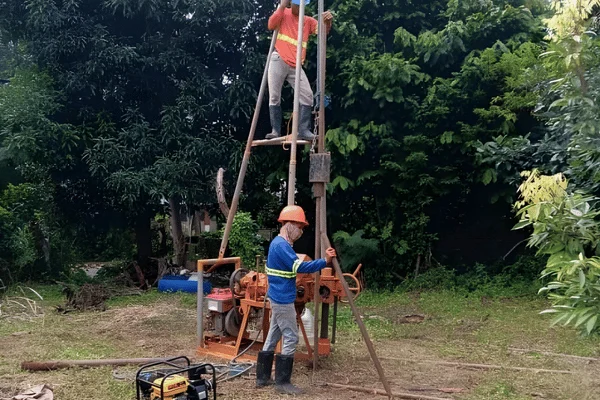
Soil investigation plays a critical role in construction planning because every structure depends on the strength and behavior of the ground beneath it. The Standard Penetration Test (SPT) serves as one of the most widely used field methods for evaluating subsurface conditions before foundation design begins.
The Standard Penetration Test (SPT) helps engineers and project owners understand how soil layers respond to mechanical impact. This information supports decisions related to foundation type, depth, and load-bearing capacity. Without proper soil investigation, construction projects face higher risks of settlement, tilting, and structural damage.
In the Philippine construction environment, varying soil profiles and seismic activity make geotechnical assessment a necessary step. The Standard Penetration Test (SPT) provides measurable field data that helps reduce uncertainty during design and construction stages.
What is the Standard Penetration Test (SPT)?
The Standard Penetration Test (SPT) is a geotechnical field testing method performed during borehole drilling. It measures soil resistance by recording the number of hammer blows required to drive a split-spoon sampler into the ground at specific intervals.
The Standard Penetration Test (SPT) produces a value known as the N-value, which reflects soil density and strength. Higher N-values indicate denser or stronger soil conditions, while lower values suggest softer or weaker layers.
The Standard Penetration Test (SPT) is widely applied because it provides practical and direct insight into subsurface conditions. It is commonly used for foundation design, settlement analysis, and soil classification in engineering projects.
Importance of Standard Penetration Test (SPT) for Construction Safety
The Standard Penetration Test (SPT) plays a major role in ensuring structural safety. Foundation systems rely heavily on accurate soil data, and incorrect assumptions about ground conditions may lead to costly structural problems.
The Standard Penetration Test (SPT) helps identify weak soil zones that may not be visible during surface inspection. These include soft clay layers, loose sand deposits, and variable fill materials that can affect stability.
The Standard Penetration Test (SPT) also supports safer engineering decisions by providing data used in bearing capacity calculations. With accurate SPT results, engineers can design foundations that match actual site conditions instead of relying on assumptions.
Construction projects across the Philippines benefit from the Standard Penetration Test (SPT) because of frequent exposure to seismic forces and diverse soil formations. Reliable soil data helps reduce risks associated with ground movement and uneven settlement.
Standard Penetration Test (SPT) Procedure
Borehole Drilling
The Standard Penetration Test (SPT) begins with borehole drilling at the selected site. The borehole allows access to subsurface soil layers at different depths. Drilling continues until the required depth for investigation is reached.
During this stage, soil samples may also be collected for classification and laboratory testing. The borehole serves as the main channel for performing the Standard Penetration Test (SPT).
Split-Spoon Sampler Testing
A split-spoon sampler is inserted into the borehole to conduct the Standard Penetration Test (SPT). A hammer with a standard weight is repeatedly dropped from a fixed height to drive the sampler into the soil.
The number of hammer blows required for each penetration interval is carefully recorded. This blow count forms the basis of the Standard Penetration Test (SPT) results.
N-Value Measurement
The Standard Penetration Test (SPT) result is expressed as the N-value, which represents the sum of hammer blows needed to penetrate specific soil depth intervals.
The N-value from the Standard Penetration Test (SPT) provides a direct indication of soil resistance. Engineers use this value to estimate soil density, shear strength, and load-bearing capacity.
Accurate recording of N-values during the Standard Penetration Test (SPT) is essential because it directly affects foundation design recommendations.
Equipment Used in Standard Penetration Test (SPT)
The Standard Penetration Test (SPT) requires specialized equipment to ensure accuracy and consistency. Key tools include drilling rigs, split-spoon samplers, hammer systems, and measuring devices.
The drilling rig creates and maintains the borehole required for the Standard Penetration Test (SPT). The split-spoon sampler collects soil samples during penetration. The hammer system delivers controlled energy to drive the sampler into the soil.
Recording instruments track the number of blows during the Standard Penetration Test (SPT), ensuring precise data collection for analysis.
Interpretation of Standard Penetration Test (SPT) Results
The Standard Penetration Test (SPT) produces data that engineers interpret to assess soil conditions. One of the most important outputs is soil classification based on resistance levels.
Low N-values from the Standard Penetration Test (SPT) usually indicate soft or loose soils, which may require deeper foundations or ground improvement. Higher N-values suggest dense or stiff soils that can support heavier loads.
The Standard Penetration Test (SPT) also supports estimation of bearing capacity, which helps determine how much load the soil can safely carry. This information guides foundation design for buildings, bridges, and other structures.
Geotechnical engineers also use Standard Penetration Test (SPT) results to identify potential liquefaction zones in sandy soils, especially in areas with seismic activity.
Applications of Standard Penetration Test (SPT) in Construction
The Standard Penetration Test (SPT) is applied across many types of construction projects. Residential buildings rely on SPT data to determine safe foundation depth and design.
Commercial developments use Standard Penetration Test (SPT) results for structural planning, especially for multi-storey buildings that require strong load-bearing capacity.
Infrastructure projects such as highways, bridges, and ports depend on the Standard Penetration Test (SPT) to evaluate ground stability and long-term performance.
The Standard Penetration Test (SPT) also supports high-rise construction, where soil strength at deeper layers becomes critical for structural safety.
Soil Conditions in the Philippines and the Role of Standard Penetration Test (SPT)
Soil conditions across the Philippines vary widely due to geological diversity and environmental factors. Coastal areas often contain sandy soils, while inland regions may have clay-rich or mixed deposits.
The Standard Penetration Test (SPT) provides essential data to understand these variations before construction begins. It helps engineers adapt foundation designs to actual site conditions instead of relying on generalized assumptions.
Seismic activity across the country also increases the importance of the Standard Penetration Test (SPT). Soil behavior during earthquakes depends on density and composition, both of which are evaluated through SPT results.
Compliance with DPWH-BRS Requirements
The Standard Penetration Test (SPT) is commonly required for compliance with government construction standards in the Philippines. Soil investigation reports are often submitted as part of permit applications and structural design reviews.
Standards set by DPWH-Bureau of Research and Standards guide the proper execution and documentation of the Standard Penetration Test (SPT).
Accurate SPT data supports engineering approval processes and helps ensure that construction projects meet required safety and performance criteria.
Field Testing and Laboratory Testing in Standard Penetration Test (SPT) Projects
The Standard Penetration Test (SPT) is part of a broader geotechnical investigation process that includes both field and laboratory work.
Field testing involves direct execution of the Standard Penetration Test (SPT) at the construction site. This step provides real-time data on soil resistance and layer conditions.
Laboratory testing follows field work and includes analysis of collected soil samples. These tests support classification, moisture content evaluation, and strength assessment.
Together, field and laboratory results from the Standard Penetration Test (SPT) process provide a complete understanding of subsurface conditions.
Why Choose Inch-On Materials Testing Laboratory
Inch-On Materials Testing Laboratory provides geotechnical soil investigation services that include the Standard Penetration Test (SPT) as part of its field testing capabilities.
The laboratory operates as an independent testing facility focused on soil and construction material verification. Services follow established ASTM and AASHTO standards to ensure consistent and reliable results.
Standard Penetration Test (SPT) services offered by the laboratory support engineers, contractors, and project owners in making informed foundation decisions. Field testing and laboratory analysis work together to deliver accurate geotechnical data for construction planning.
Takeaway
The Standard Penetration Test (SPT) remains a core method in geotechnical soil investigation for construction projects in the Philippines. It provides essential information about soil strength, density, and behavior that directly influences foundation design and structural safety.
Reliable SPT results help reduce construction risks, support compliance with regulatory requirements, and improve long-term performance of buildings and infrastructure. Proper execution of the Standard Penetration Test (SPT) ensures that engineering decisions are based on actual ground conditions rather than assumptions.
Frequently Asked Questions (FAQ)
What is the Standard Penetration Test (SPT)?
The Standard Penetration Test (SPT) is a field test used during borehole drilling to measure soil resistance using a hammer-driven sampler.
What does the SPT N-value mean?
The N-value represents the number of hammer blows required to drive the sampler into the soil. It indicates soil density and strength.
Why is the Standard Penetration Test (SPT) important for foundations?
The Standard Penetration Test (SPT) provides data used to determine safe foundation depth and load-bearing capacity, helping reduce structural risks.
How deep is the Standard Penetration Test (SPT) performed?
The depth depends on project requirements, soil conditions, and design needs, often extending until competent soil layers are reached.
Who needs Standard Penetration Test (SPT) results?
Residential, commercial, and infrastructure projects require Standard Penetration Test (SPT) results to support safe and compliant foundation design.